Assign people to framework levels
Publishing makes the framework visible. Applying it to people is what makes it operational.
Where to assign member levels
You can assign levels from member management in either of these views:
- Workspace Settings > Members
- Org > Company Hub > List
Open the member, edit details, and select a level from the published framework.
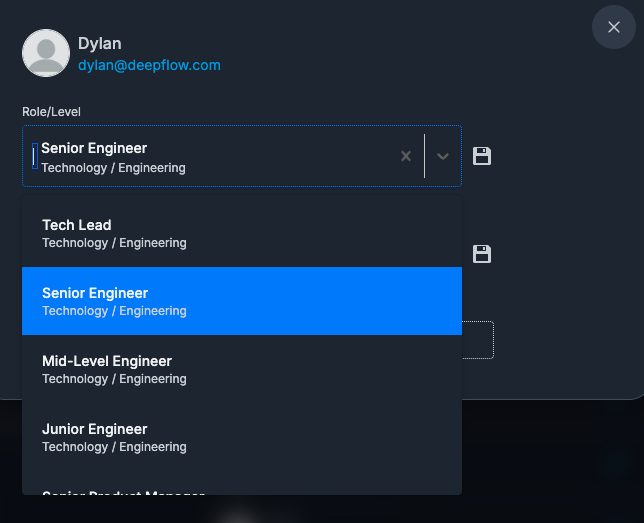
Only workspace owners can manage these assignments.
Why level assignment matters
Without level assignment, the framework remains a reference document. With assignment, it becomes part of day-to-day growth management.
For individuals, it clarifies current expectations and progression. For managers, it creates a consistent baseline for coaching, feedback, and goal setting.
A practical way to assign levels well
Use evidence, not titles alone.
Before assigning, look at:
- scope and complexity of work,
- consistency of delivery,
- independence and decision quality,
- influence on team outcomes.
Then choose the level that best matches demonstrated behavior, not aspirational positioning.
Assignment steps
- Confirm a framework is published.
- Open a member management view.
- Open the person’s edit dialog.
- Select the level.
- Save.
If no framework is published, framework levels are not available for assignment.
What changes after assignment
For the individual:
- their profile is mapped to a level,
- growth conversations become more concrete,
- progression expectations are easier to understand.
For managers:
- coaching conversations can use shared level language,
- feedback and goals can be anchored to the same framework,
- progression reviews are easier to run consistently across reports.
Keep assignments current
Revisit assignments when:
- role or track changes,
- promotion decisions are finalized,
- scope has changed materially,
- a newly published framework changes progression definitions.
Common mistakes
- Assigning levels before the framework language is mature.
- Treating levels as job titles instead of expectation bands.
- Leaving new joiners unassigned for too long.